
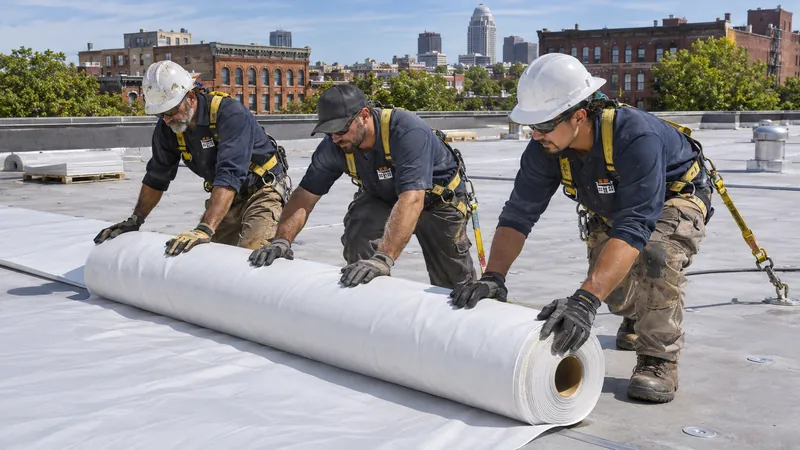
TPO Membrane
- Color
- White, reflective
- Seams
- Hot-air welded
- Best Buildings
- Warehouses and retail centers
- Summer Heat
- Reflects sun off the roof
- Repairs Later
- Welded patches on clean TPO
Commercial Roofing Service
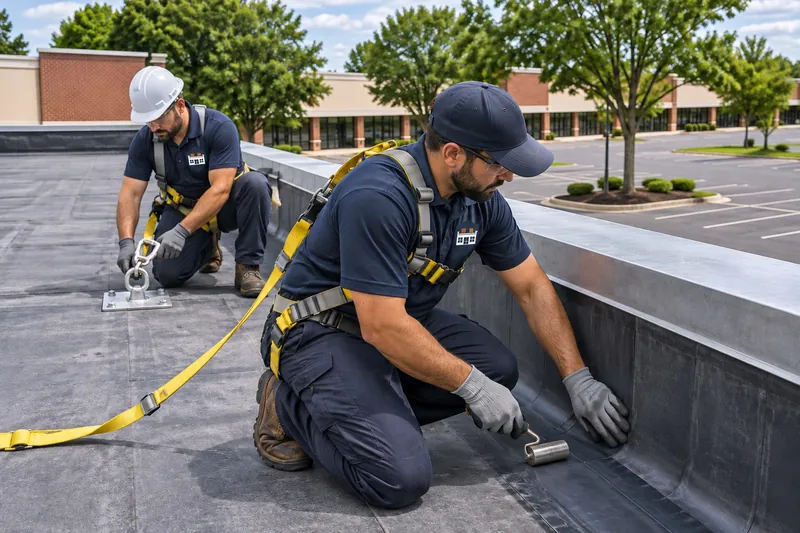
Louisville TPO roofing covers new installs, recovers, and repairs of white thermoplastic membrane on warehouses, plants, offices, and retail centers.
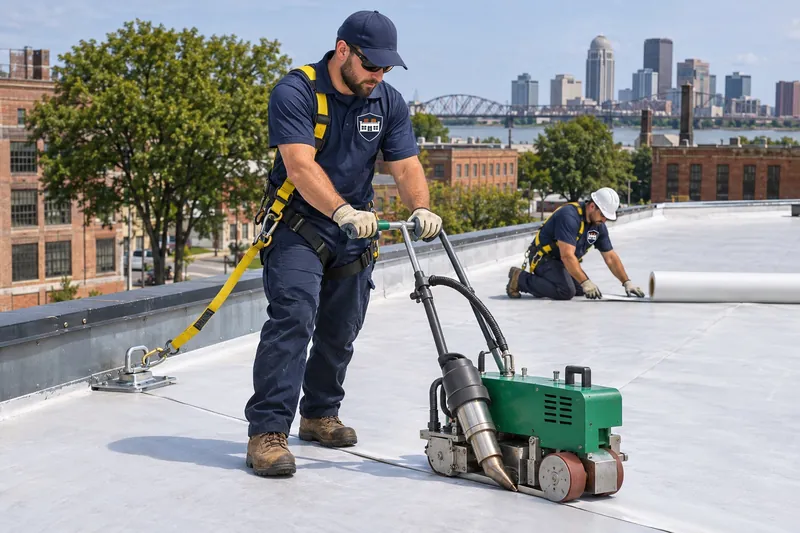
TPO Fit
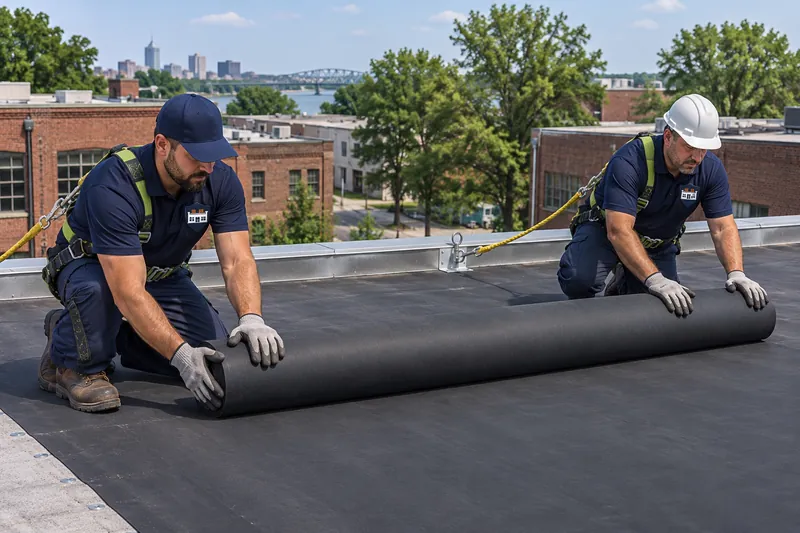
Louisville TPO roofing and EPDM cover most flat commercial roofs here. The building decides which one fits.
TPO Problems
TPO is a durable membrane, but these four problems show up on Louisville TPO roofs as they age.
A seam welded too cold peels open over time. Probing finds the weak lengths, which are cleaned and rewelded. Test welds at the start of each day help prevent cold welds on new TPO.
Usually Means: Welder heat or speed was off during install
Tools and boots near rooftop units puncture TPO.
Aging TPO can pull at corners and curbs, stressing the flashing.
Water that sits on TPO collects dirt and wears the surface.
Older TPO flashing around unit curbs cracks at inside corners.
TPO Options
TPO can go on several ways. The attachment method depends on the deck, the wind exposure, and the insulation plan.
| Method | How It Goes Down | Common Use |
|---|---|---|
| Mechanically Attached | Plates and screws through the seams into the deck | Large steel-deck warehouses |
| Fully Adhered | Glued to cover board with adhesive | Offices and roofs with odd shapes |
| Induction Welded | Membrane welded to plates under it | Higher wind areas and fewer seam fasteners |
| TPO Recover | Over one dry existing layer with cover board | Roofs that qualify for a recover |
| TPO Repair | Cleaned, primed, and welded patches | Punctures and split seams on existing TPO |
Why TPO
TPO offers several practical advantages on Louisville commercial buildings with large low-slope roofs.
The white membrane reflects summer sun, which helps buildings with heavy cooling loads keep roof temperatures down.
Hot-air welding fuses the laps into one piece, which holds up better than glued seams on a big roof.
A white TPO surface reflects summer sun off the roof field, which helps warehouses and retail spaces below with heavy cooling loads.
Welded seams and flashed curbs keep water away from racking, inventory, and finished goods under big warehouse roofs.
Clean, primed TPO accepts welded patches, so punctures and seam failures can be fixed for years.
Clean TPO takes a welded patch for years, so future punctures near rooftop units stay small, inexpensive repairs.
Call with the building size and the current roof type. We will walk it, count the layers, and price TPO options in writing.
TPO Process
TPO goes down in a set order so every seam can be welded and probed before the crew leaves the roof.
We check the deck, the existing layers, and the drains, and take cores to find wet boards before planning the TPO.
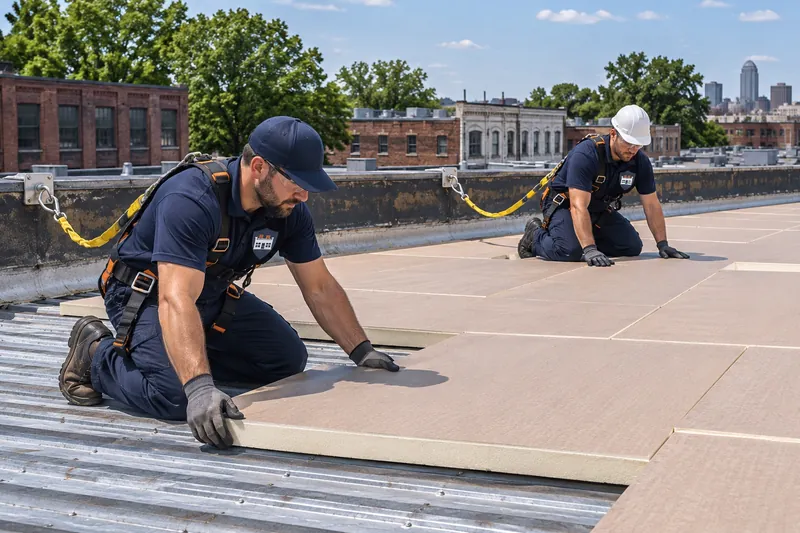
Old roofing or wet boards come off, then polyiso and cover board go down with tapered sections toward the drains.
Wide TPO rolls are laid out and attached, and an automatic welder runs every seam at a set heat and speed.
Each seam is probed, curbs and walls are flashed, and edge metal is set before the final roof walk.
About TPO
TPO is a single-ply thermoplastic membrane, usually white, that comes in wide rolls and joins at the laps with hot air instead of glue. On the large, open roofs of Louisville warehouses, distribution centers, and retail centers, that combination means fewer seams and a reflective surface over spaces that get hot in summer.
A TPO roof is only as good as what sits under it, so insulation, cover board, and drain heights get as much planning as the membrane itself.
Related Services
These services sit close to TPO work on most Louisville roofs.
Full tear-off when the existing roof is too wet or worn for a TPO recover.
DetailsTPO compared with EPDM, and what to know before putting TPO on a warehouse.
Roof Condition
TPO is white thermoplastic with heat-welded seams and a reflective surface. EPDM is black synthetic rubber with taped or adhered seams that stays flexible in cold weather. On Louisville flat roofs the better choice comes down to the building's cooling load, movement, deck, and any existing membrane to match.
Yes, for most of them. Wide TPO rolls and welded seams keep seam counts low on big warehouse and distribution roofs, and the white surface reflects summer heat. Before installing it, we check the deck, the insulation, and the drains, since those decide how long the new membrane lasts.
Membranes and Systems
If there is only one existing layer and the insulation is dry, a TPO recover over a cover board is often possible. Two existing layers, or wet boards found in core samples, mean a tear-off first.
Every TPO seam is probed along its full length after welding, and test welds are made at the start of each day to set the welder's heat and speed. Any cold or narrow weld found by the probe gets rewelded before the crew moves on.
Planning the Work
Thicker TPO sheets hold up better to foot traffic and hail on busy warehouse roofs. We match the thickness to the traffic, rooftop equipment, and wind exposure of your building and list it in the written scope.
Yes for most commercial buildings. The reflective surface helps most during Louisville's hot, humid summers, and with good insulation under the membrane the winter heat loss stays low. Snow and ice sit on TPO the same way they sit on any low-slope roof, so drains need to stay clear.
Next Step
Send the address and roof size if you know it. We walk the roof and price TPO install, recover, or repair options in writing.
Roof Leaking or Wearing Out? Have Us Call You
Leave a name and number to talk about your roof.
Thank You. Your Request Is In.
We have your name and number and will call you about the roof. To talk now, call (502) 293-5786.
Or call (502) 293-5786