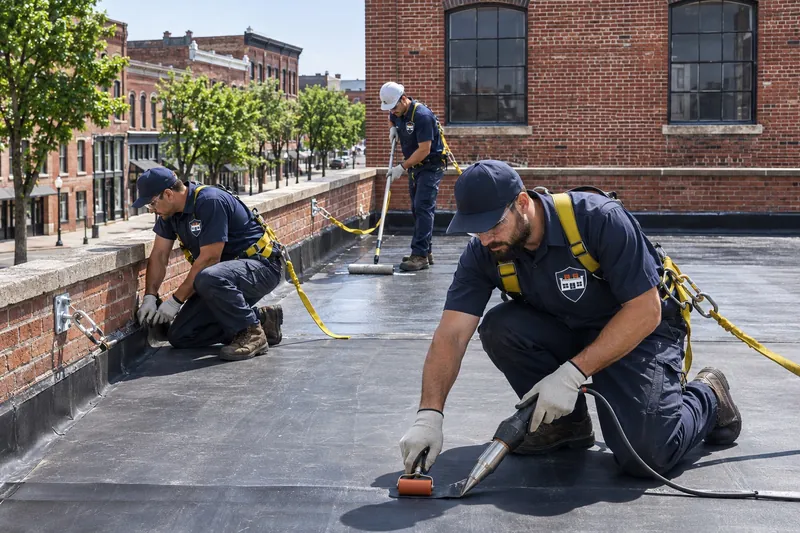
EPDM Membrane
- Flexibility
- Stays pliable in winter cold
- Seams
- Primed tape and cover strip
- Movement
- Handles joints and additions well
- Surface
- Black rubber
- Matching Old Roofs
- Ties into existing EPDM
Commercial Roofing Service
Louisville EPDM roofing covers new rubber roofs, seam and patch repairs, and replacements on offices, schools, churches, and low-rise commercial buildings.
EPDM Fit
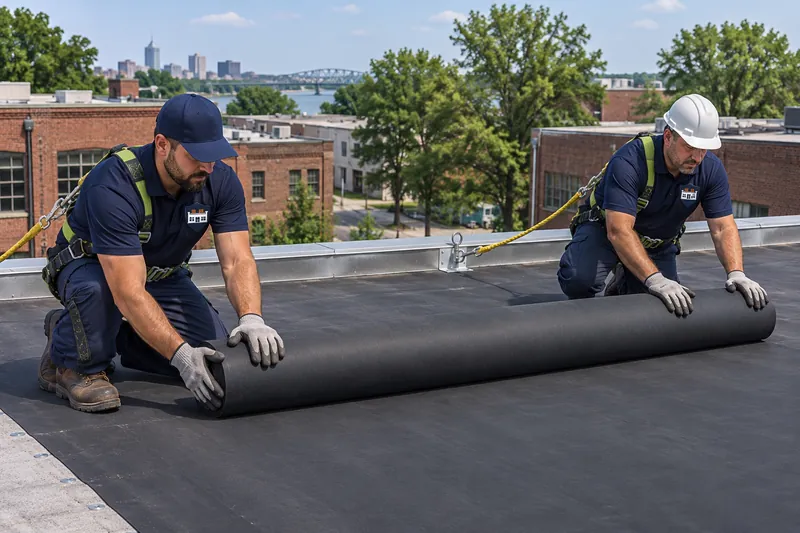
Louisville EPDM roofing suits buildings that move and face cold winters. Here is how it compares with TPO.
EPDM Problems
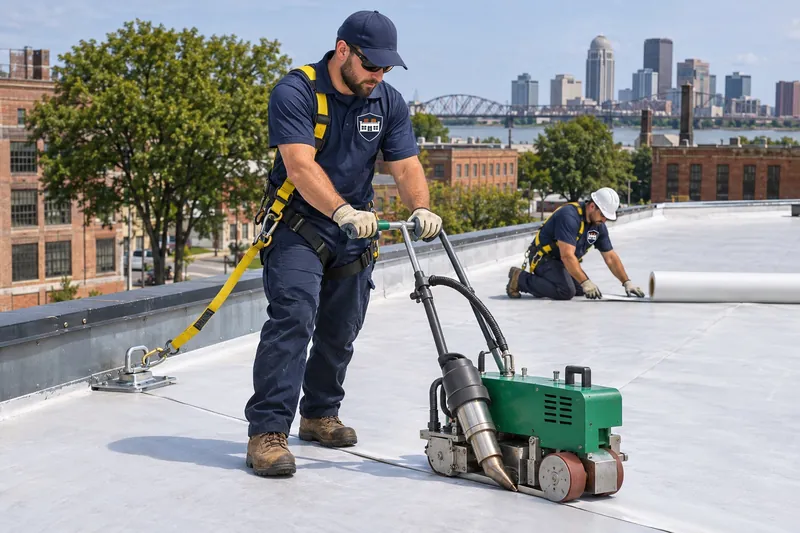
Older EPDM roofs around Louisville tend to fail in these four places first.
Seams installed without good primer lift over the years. We clean back to bare rubber, prime, and apply new tape and cover strips. Primer is what lets new tape grab old rubber, so it never gets skipped.
Usually Means: The original seams went down without primer
Aging EPDM shrinks and tents at walls and curbs.
Hail, tools, and debris cut rubber roofs.
Water that sits on EPDM finds weak seams.
Rubber boots around pipes split with age, and curb flashing peels.
EPDM Options
EPDM can be installed or repaired in several ways. The deck, wind exposure, and existing roof decide which one we use.
| Option | How It Works | Where It Fits |
|---|---|---|
| Fully Adhered EPDM | Rubber glued to cover board with adhesive | Most office and school roofs |
| Mechanically Attached EPDM | Fastened through seam plates into the deck | Large steel-deck roofs |
| Ballasted EPDM | Loose-laid and held by stone | Existing ballasted roofs with structure to carry it |
| Seam Re-Tape | Old seams cleaned, primed, and covered | Lifted seams on aging EPDM |
| Patch and Cover Strip | Primed patch over holes and tears | Punctures and small splits |
Why EPDM
EPDM brings a few clear advantages to Louisville commercial roofs, especially on buildings that move or face cold winters.
EPDM stays pliable through Kentucky freeze-thaw cycles, so the membrane moves with the building instead of cracking.
Buildings with expansion joints or additions benefit from a membrane that tolerates movement at transitions.
Rubber seams re-taped and flashing reset at walls keep water out of offices, classrooms, and halls below.
Catching lifted seam tape early keeps water from soaking ceiling tiles in schools, churches, and clinics.
Since primed patches bond to rubber for years, an EPDM roof can be repaired in small steps as it ages.
Rubber takes a primed patch even after many years, which keeps repair costs down as the roof ages.
Call with the building type and where the seams are opening. We will check whether a re-tape fixes it or the roof is due for replacement.
EPDM Process
Rubber membrane rewards careful prep. Clean, primed surfaces are what make EPDM seams and patches last.
We check seams, flashing, and drains, then take cores to see whether the insulation under the rubber is dry.
Wet boards come out and new insulation and cover board go down, sloped toward drains where ponding was found.
EPDM sheets are unrolled, relaxed, and adhered, then seams are primed and taped with cover strips at the laps.
Curbs, pipes, and walls get flashed, edge metal goes on, and we walk the finished roof with you.
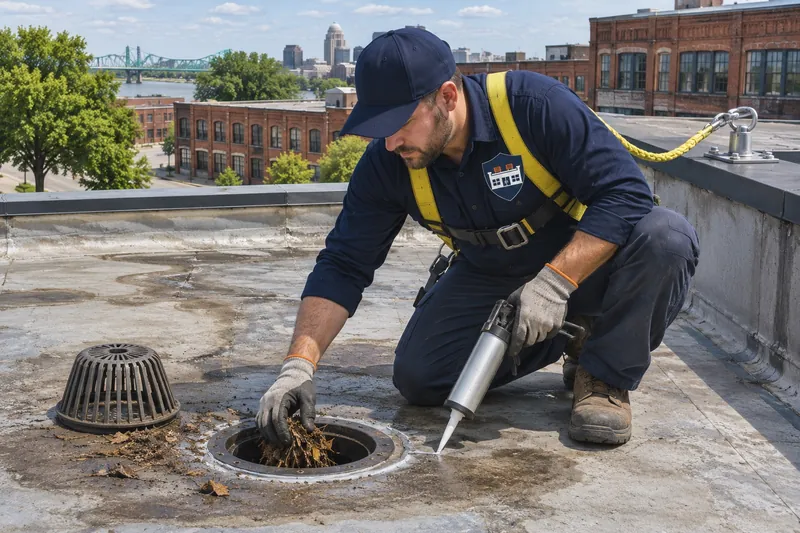
About EPDM
EPDM is a synthetic rubber membrane, usually black, that has covered low-slope roofs on Louisville offices, schools, churches, and low-rise commercial buildings for decades. It comes in large sheets, so a single sheet covers a lot of roof with few laps.
Many older EPDM roofs in the area still have life left in the rubber itself. The usual weak points are seams that were never primed and flashing pulled by shrinkage at walls and curbs, and both can be repaired.
Related Services
These services come up often alongside EPDM repairs and installs in Louisville.
Core samples to learn whether old rubber can stay or has to come off.
DetailsWhen to choose rubber, and how EPDM holds up on Louisville roofs.
Roof Condition
EPDM makes more sense on Louisville buildings with roof movement, an existing EPDM roof to repair or match, or owners who want a rubber membrane that patches cleanly for decades. On buildings where summer cooling costs dominate, white TPO can be the better choice.
Yes, when the rubber itself is still flexible and the insulation is dry. Seams are cleaned back to bare rubber, primed, and covered with new seam tape. If seams are failing everywhere and cores find wet boards, replacement is the better spend.
Membranes and Systems
A black roof absorbs more summer sun than a white one, so the roof surface runs hotter. How much that matters depends on insulation and the building's cooling load. Offices and schools with good insulation often see little difference inside.
Sometimes. If the built-up roof is the only layer and core samples show dry insulation, EPDM can go over a cover board on top of it. Gravel has to be removed and blisters cut and flattened first. Wet or doubled roofs get torn off instead.
Planning the Work
Yes, with care. EPDM stays flexible in the cold, but adhesives and seam primers have temperature limits, so the work is planned for dry days within those limits and seams are covered if the weather turns.
EPDM roofs often reach 20 years or more with maintenance, and the rubber itself can last longer than its seams. Seam upkeep, drain clearing, and quick patching of punctures are what keep an EPDM roof working through its full life.
Next Step
Tell us the address and the age of the roof if you know it. We will walk the rubber, check the seams, and price each option.
Roof Leaking or Wearing Out? Have Us Call You
Leave a name and number to talk about your roof.
Thank You. Your Request Is In.
We have your name and number and will call you about the roof. To talk now, call (502) 293-5786.
Or call (502) 293-5786